Iowa basketball picked up a substantially-needed acquire on Saturday afternoon as the Hawkeyes took down Michigan State, 112-106, in overtime. The Hawkeyes were down 13 details with 1:30 remaining in the next half, but uncovered a way to arrive back and pressure overtime. Iowa then took care of small business in the extra five minutes to safe the victory.
Iowa arrived into the activity losers of two straight contests and a decline would not have helped the Hawkeyes’ resume. Iowa is on the brink of generating its fourth NCAA Match in five seasons, with the lone a single it skipped being the COVID 12 months. Experienced it been a usual event, Iowa would’ve been in the field, way too.
“Yeah, all over the system of the yr, a great deal of things transpire,” Iowa head mentor Fran McCaffery said previous 7 days. “You have accidents. You think about when we played a 10:30 match in New York and received household at 5 a.m., and we had to play less than 40 hrs later on. The young ones performed great. You just go on to the next. You don’t obsess about it. We bussed residence yesterday, we didn’t bus residence immediately after the video game. So what? We’re heading to bus property one way or the other. What distinction does it make what time we get back?”
“You have to stay locked in, and if you have some guys that are out, you action up and do your job.”
The Hawkeyes have two regular year game titles remaining on the street at Indiana and then at dwelling towards Nebraska. Immediately after that, Iowa will enjoy in the Big 10 Match. There is a great deal that continue to can figure out the seeding in the meeting match.
As of Sunday, it seems that Iowa is a sixth seed in the Massive Ten as it retains the tiebreaker more than Illinois in the head-to-head group. There are seven teams in the Massive Ten with eight, nine, or 10 meeting wins, so a ton will be decided in this final 7 days of the frequent time.
Other folks teams on the seven, 8, and 9 lines in order (Bracket Matrix): Maryland, Michigan Point out, Texas A&M, Duke, Providence, Kentucky, Arkansas, IOWA, Missouri, NC Point out, Auburn, and Rutgers
Other projected Massive 10 groups in the discipline (Bracket Matrix – Updated on Feb. 26): Purdue (No. 1 seed), Indiana (No. 4 seed), Northwestern and Illinois (No. 6 seeds), Maryland and Michigan Condition (No. 7 seeds), Iowa (No. 8 seed), Rutgers (No. 9 seed), and Wisconsin (No. 11 seed)
Significant Ten teams on the bubble:Penn Point out and Michigan
You can get anonce-a-year membership for 30{b7c9e2c88beb1a84f22d94ab877a147f4adc4b3519717f3f957a0f34e16918d1} off.Acquire benefit now and be the to start with to know every thing heading on concerning Iowa soccer, basketball, and recruiting!Click In this article!
Cloud and edge networks are placing up a new line of protection, identified as confidential computing, to protect the expanding prosperity of details people approach in those environments.
Private Computing Defined
Confidential computing is a way of shielding data in use, for example although in memory or throughout computation, and avoiding any one from viewing or altering the perform.
Making use of cryptographic keys linked to the processors, confidential computing makes a reliable execution surroundings or secure enclave. That harmless electronic place supports a cryptographically signed proof, named attestation, that the hardware and firmware is properly configured to stop the viewing or alteration of their data or software code.
In the language of protection specialists, confidential computing gives assurances of knowledge and code privateness as well as information and code integrity.
What Can make Private Computing Exclusive?
Private computing is a reasonably new capability for defending info in use.
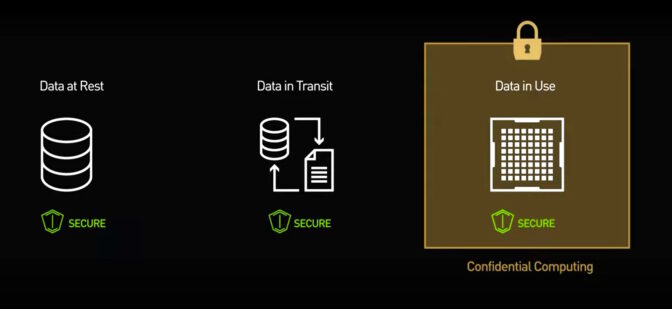
For several yrs, personal computers have utilized encryption to secure data that’s in transit on a network and details at relaxation, stored in a drive or non-volatile memory chip. But with no useful way to run calculations on encrypted info, users confronted a hazard of owning their facts viewed, scrambled or stolen when it was in use within a processor or main memory.
With private computing, methods can now include all three legs of the details-lifecycle stool, so information is in no way in the obvious.
Private computing adds a new layer in pc stability — defending knowledge in use when functioning on a processor.
In the past, computer system safety primarily centered on protecting facts on programs customers owned, like their company servers. In this situation, it’s all right that system software sees the user’s data and code.
With the advent of cloud and edge computing, customers now routinely operate their workloads on desktops they don’t own. So private computing flips the focus to protecting the users’ data from whoever owns the equipment.
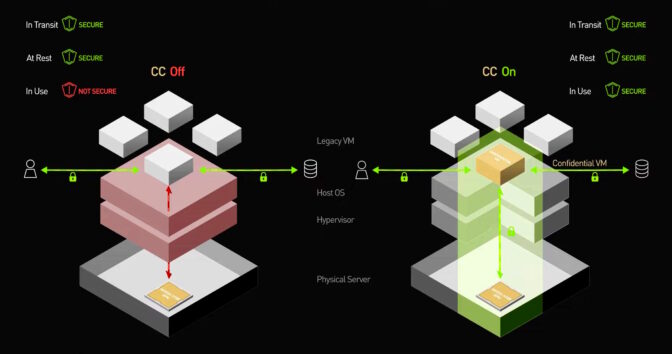
With private computing, software jogging on the cloud or edge laptop or computer, like an running procedure or hypervisor, still manages function. For example, it allocates memory to the person application, but it can under no circumstances read or alter the info in memory allocated by the user.
How Private Computing Received Its Name
A 2015 investigation paper was one of many applying new Safety Guard Extensions (Intel SGX) in x86 CPUs to display what is possible. It identified as its technique VC3, for Verifiable Confidential Cloud Computing, and the identify — or at the very least element of it — trapped.
“We started out calling it confidential cloud computing,” claimed Felix Schuster, direct author on the 2015 paper.
Four many years later, Schuster co-established Edgeless Devices, a firm in Bochum, Germany, that develops resources so users can make their individual confidential-computing apps to increase data defense.
Confidential computing is “like attaching a deal to your details that only allows specific matters to be finished with it,” he said.
How Does Private Computing Perform?
Taking a deeper look, private computing sits on a foundation referred to as a root of trust, which is primarily based on a secured crucial distinctive to each and every processor.
The processor checks it has the proper firmware to get started working with what is named a safe, calculated boot. That course of action spawns reference information, verifying the chip is in a acknowledged risk-free condition to commence work.
Up coming, the processor establishes a safe enclave or dependable execution surroundings (TEE) sealed off from the rest of the process where the user’s application runs. The application brings encrypted information into the TEE, decrypts it, operates the user’s application, encrypts the outcome and sends it off.
At no time could the device proprietor perspective the user’s code or information.
A single other piece is important: It proves to the consumer no one particular could tamper with the knowledge or program.
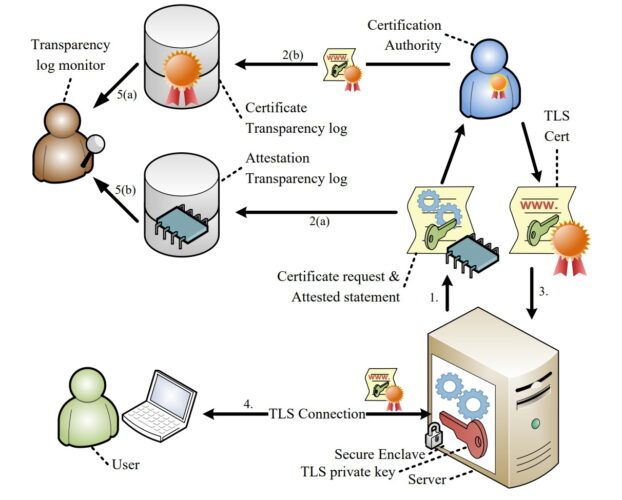
Attestation takes advantage of a private key to build stability certificates stored in general public logs. Buyers can obtain them with the web’s transportation layer protection (TLS) to verify confidentiality defenses are intact, protecting their workloads.
The proof is shipped via a multi-stage procedure termed attestation (see diagram over).
The very good news is researchers and commercially offered companies have demonstrated confidential computing is effective, usually furnishing info safety without substantially impacting overall performance.
A significant-degree search at how private computing will work.
Shrinking the Safety Perimeters
As a final result, consumers no more time have to have to rely on all the application and techniques administrators in separate cloud and edge companies at remote destinations.
Private computing closes numerous doors hackers like to use. It isolates systems and their facts from attacks that could appear from firmware, working programs, hypervisors, virtual machines — even bodily interfaces like a USB port or PCI Categorical connector on the laptop or computer.
The new stage of safety guarantees to lessen knowledge breaches that rose from 662 in 2010 to extra than 1,000 by 2021 in the U.S. by yourself, according to a report from the Id Theft Source Center.
That reported, no stability measure is a panacea, but private computing is a wonderful stability instrument, placing command straight in the hands of “data owners”.
Use Scenarios for Confidential Computing
Consumers with sensitive datasets and regulated industries like banks, healthcare providers and governments are between the to start with to use confidential computing. But that’s just the start.
Because it protects delicate facts and mental home, confidential computing will enable teams truly feel they can collaborate properly. They share an attested proof their content material and code was secured.
Illustration programs for confidential computing involve:
Businesses executing intelligent contracts with blockchains
Investigation hospitals collaborating to teach AI versions that examine developments in individual information
Shops, telecom suppliers and other folks at the network’s edge, defending private details in places the place physical obtain to the computer is attainable
Software package vendors can distribute products and solutions which contain AI products and proprietary algorithms when preserving their mental property
Even though private computing is finding its commence in public cloud expert services, it will unfold rapidly.
Users will need confidential computing to safeguard edge servers in unattended or challenging-to-reach areas. Business knowledge centers can use it to guard against insider attacks and guard one private workload from a further.
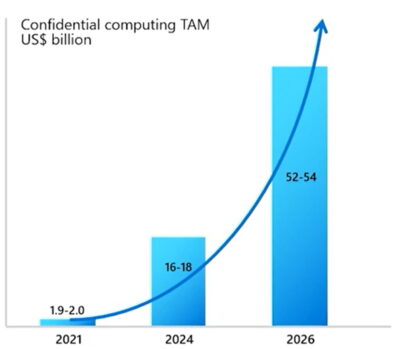
Industry scientists at Everest Team estimate the offered industry for private computing could improve 26x in 5 years.
So significantly, most end users are in a evidence-of-principle stage with hopes of placing workloads into output quickly, said Schuster.
On the lookout ahead, private computing will not be minimal to unique-goal or sensitive workloads. It will be applied broadly, like the cloud services hosting this new stage of security.
In truth, experts predict confidential computing will develop into as widely utilised as encryption.
The technology’s prospective motivated suppliers in 2019 to start the Confidential Computing Consortium, section of the Linux Basis. CCC’s members consist of processor and cloud leaders as perfectly as dozens of program organizations.
The group’s tasks include the Open Enclave SDK, a framework for setting up dependable execution environments.
“Our most important mandate is supporting all the open-source initiatives that are foundational sections of the ecosystem,” explained Jethro Beekman, a member of the CCC’s technological advisory council and vice president of technological know-how at Fortanix, 1 of the very first startups started to produce confidential computing computer software.
“It’s a powerful paradigm to set protection at the facts level, fairly than get worried about the particulars of the infrastructure — that need to final result in not needing to examine about facts breaches in the paper just about every working day,” mentioned Beekman, who wrote his 2016 Ph.D. dissertation on confidential computing.
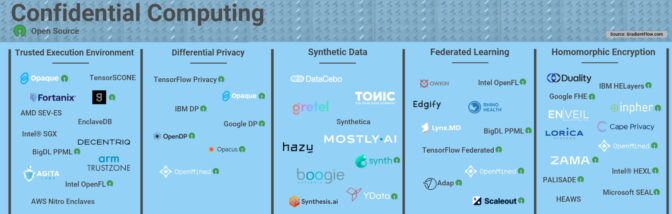
A rising sector of safety businesses is doing the job in confidential computing and adjacent regions. (Supply: GradientFlow)
How Confidential Computing Is Evolving
Implementations of confidential computing are evolving rapidly.
At the CPU stage, AMD has launched Secure Encrypted Virtualization with Safe Nested Paging (SEV-SNP). It extends the course of action-stage protection in Intel SGX to complete digital machines, so consumers can employ confidential computing with no needing to rewrite their programs.
Top rated processor makers have aligned on supporting this tactic. Intel’s help comes through new Trusted Area Extensions. Arm has explained its implementation, known as Realms.
Proponents of the RISC-V processor architecture are utilizing confidential computing in an open up-source task called Keystone.
Accelerating Confidential Computing
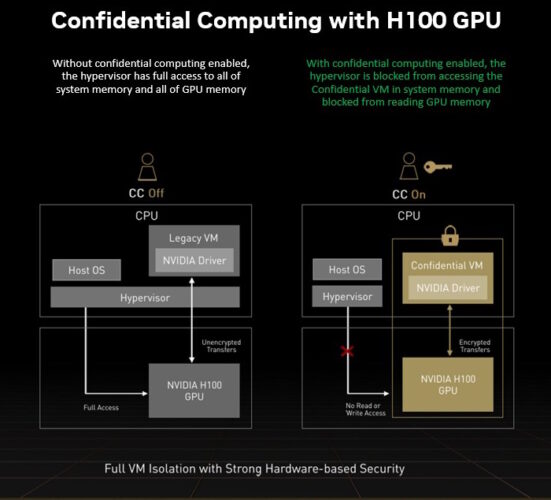
NVIDIA is bringing GPU acceleration to VM-style private computing to market place with its Hopper architecture GPUs.
The H100 Tensor Main GPUs enable confidential computing for a wide swath of AI and significant effectiveness computing use cases. This gives users of these safety services entry to accelerated computing.
An example of how GPUs and CPUs operate jointly to provide an accelerated confidential computing services.
In the meantime, cloud service providers are presenting services today dependent on one particular or more of the underlying technologies or their possess special hybrids.
What’s Up coming for Private Computing
More than time, industry suggestions and expectations will arise and evolve for features of private computing such as attestation and productive, protected I/O, explained Beekman of CCC.
Whilst it is a reasonably new privacy software, private computing’s ability to shield code and info and deliver assures of confidentiality makes it a highly effective one.
Hunting forward, experts anticipate private computing will be blended with other privacy solutions like fully homomorphic encryption (FHE), federated learning, differential privateness, and other types of multiparty computing.
Using all the elements of the modern-day privacy toolbox will be key to success as need for AI and privateness grows.
So, there are numerous moves forward in the great chess match of stability to defeat the difficulties and know the positive aspects of private computing.
Choose a Deeper Dive
To understand additional, look at “Hopper Confidential Computing: How it Performs Under the Hood,” session S51709 at GTC on March 22 or later on (absolutely free with registration).
Check out out “Confidential Computing: The Developer’s Look at to Protected an Application and Details on NVIDIA H100,” session S51684 on March 23 or later on.
You also can attend a March 15 panel dialogue at the Open up Private Computing Conference moderated by Schuster and showcasing Ian Buck, NVIDIA’s vice president of hyperscale and HPC. And watch the online video under.
Apple Inc.’s Chinese suppliers are probable to go potential out of the place much more rapidly than many observers foresee to pre-empt fallout from escalating Beijing-Washington tensions, according to a single of the US company’s most crucial companions.
AirPods maker GoerTek Inc. is one of the quite a few makers exploring spots over and above its indigenous China, which these days cranks out the bulk of the world’s gizmos from iPhones to PlayStations. It’s investing an original $280 million in a new Vietnam plant while looking at an India growth, Deputy Chairman Kazuyoshi Yoshinaga said in an interview. US tech businesses in certain have been pushing challenging for brands like GoerTek to explore different areas, mentioned the govt, who oversees GoerTek’s Vietnamese operations from northern Bac Ninh province.
“Starting from previous month, so quite a few people from the consumer aspect are viewing us pretty much each and every day,” Yoshinaga mentioned from his offices at GoerTek’s sprawling industrial intricate north of Hanoi. The subject matter that dominates discussions: “When can you go out?”
The expanding conflict between the US and China, which started with a trade war but has considering the fact that expanded to encompass sweeping bans on the trade of chips and money, is spurring a rethink of the electronics industry’s decades-previous supply chain. The world’s reliance on the Asian country became starkly very clear through the Covid Zero yrs, when Beijing’s restrictions choked off the supply of anything from telephones to automobiles.
Apple’s suppliers almost never remark on its wondering, in section because of the US company’s famed insistence on secrecy throughout its world wide supply chain.
The Apple iphone maker has kept mum on no matter if it strategies to diversify out of China, which would entail revamping a design Main Executive Officer Tim Prepare dinner pioneered underneath Steve Work. The US big has been cautious to avoid suggestions it may well minimize its investment decision in China, wherever it’s constructed an ecosystem centered on organizations these kinds of as GoerTek and Foxconn Engineering Group, which collectively make use of thousands and thousands.
Driving the scenes, 9 out of 10 of Apple’s most significant suppliers may perhaps be getting ready significant-scale moves to nations like India, which is dangling incentives to travel Narendra Modi’s Make in India initiative. Bloomberg Intelligence estimates it could take eight years to shift just 10{b7c9e2c88beb1a84f22d94ab877a147f4adc4b3519717f3f957a0f34e16918d1} of Apple’s ability outdoors of China.
The GoerTek executive argues it’ll be significantly faster.
Most Chinese tech brands are suffering from the similar pressure. “I would say at present 90{b7c9e2c88beb1a84f22d94ab877a147f4adc4b3519717f3f957a0f34e16918d1} of them, they are wanting at that,” he additional. “It’s the brand name companies’ conclusions.”
India is large on clients’ would like-lists — a reflection of its likely the two as a market place and a manufacturing foundation.
“We get requests from our customers almost just about every thirty day period. ‘Do you have any programs to develop to India?’” Yoshinaga stated. “If they make your mind up to construct up the creation traces in India, we might have to believe about it severely. At present we are concentrating on developing our Vietnam output services.”
Vietnam for now is the company’s sole producing web site outdoors of China. The envisioned new 62-hectare sophisticated in Bac Ninh will make goods for major US brands and is anticipated to be operational in just a 12 months, Yoshinaga informed Bloomberg Information. That financial investment will incorporate to the $1.06 billion of commitments that GoerTek’s made in Bac Ninh and the north-central province of Nghe An, he added.
GoerTek, which also programs to manufacture digital truth headsets in Vietnam from 2024, expects the Southeast Asian place to generate a lot more than half of its world-wide revenues in a few several years, up from 1-third now, Yoshinaga claimed. The firm is also inquiring its possess suppliers to scout northern Vietnam for new factories, he stated. It can make Quest virtual reality headsets for Meta Platforms Inc. and Sony Group Corp.’s PSVR equipment.
GoerTek established up operations in Vietnam a 10 years ago to make acoustic merchandise at the request of Samsung Electronics Co., he said. The supplier now operates eight vegetation in the place, and expects to double its local workforce to 40,000 as before long as Might to ramp up for Xmas, Yoshinaga mentioned.
Vietnam’s proximity to China, a coastal community of ports, youthful educated workforce and relative political balance make the Southeast Asian place an suitable hub, he said. But an anti-corruption campaign, which led to the modern dismissal of the president and two deputy key ministers, is unsettling, explained Yoshinaga, who reported he’s expressed that problem to officers.
Led by Communist celebration chief Nguyen Phu Trong, the effort and hard work has rattled marketplaces and investors. In 2021, Chinese President Xi Jinping launched an anti-corruption probe aimed at the nation’s $60 trillion economical sector.
“They understand far too a lot from China,” Yoshinaga mentioned of Vietnam’s leadership. “Doing a little something about corruption is fantastic. But never go way too significantly and produce an unstable political natural environment.”
For now, Vietnam stays an appealing area. Apple might be hunting to make the country a manufacturing hub for AirPods, iPads and MacBooks. AirPods orders are dominated by GoerTek and fellow Chinese organization Luxshare Precision Industry Co., which much too has a complex in north Vietnam.
Several US providers are setting up to change production there, regardless of value, Yoshinaga claimed. Many others like Jabil Inc. are considering India. But all round, the stream is consistently heading to be outward from China, he reported.
“I do not consider it is likely to return. It’s a person-way.”
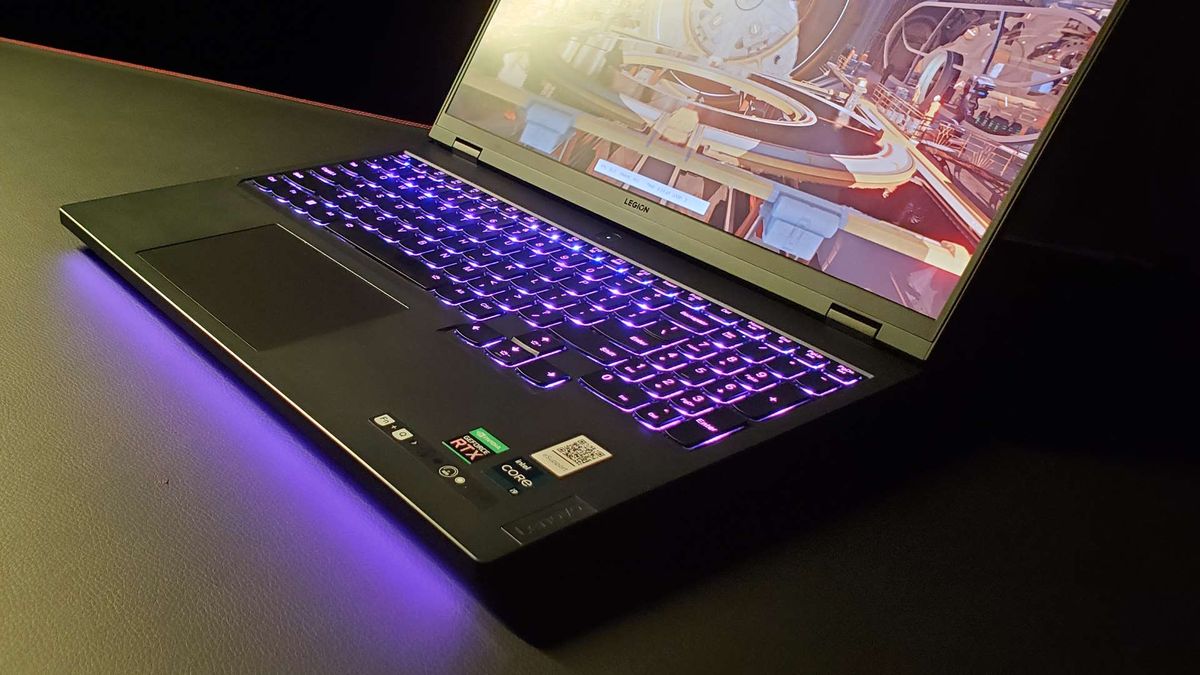
The new Lenovo Legion Pro 7i is an outstanding next-gen gaming laptop. It’s a machine that comes in at a price point that makes the rest of the high-end RTX 40-series look even more ridiculous on their lofty $4,000+ perches. And its RTX 4080 GPU gives it the sort of gaming performance that has me questioning why anyone would want an RTX 4090 machine (opens in new tab).
This is the first gaming laptop I’ve seen using the second-tier Ada Lovelace GPU from Nvidia, and it’s a doozy.
Like the RTX 4090 before it, the numbering system Nvidia is using for its mobile graphics silicon is a step removed from that inside the desktop versions of the same name. While Nvidia might be making a big deal of the fact xx90-class GPUs are going into laptops for the first time, they’re not the same as the graphics chompers in the latest and greatest gaming PCs.
The mobile RTX 4090 uses the same AD103 GPU as the desktop RTX 4080 (opens in new tab), though the mobile RTX 4080 is actually built from a cut-down version of the AD104 used inside the desktop RTX 4070 Ti (opens in new tab).
Legion Pro 7i specs
(Image credit: Future)
CPU: Intel Core i9 13900HX Cores | Threads: 24 | 32 Boost clock: 5.4GHz GPU: Nvidia RTX 4080 (150W) Cores: 7,424 VRAM: 12GB System Memory: 32GB DDR5-5600 Storage: 1TB NVMe SSD Screen: 16-inch Resolution: UHD+ 240Hz Price:$2,750 (opens in new tab) | £2,800 (opens in new tab)
That means you’re getting 7,424 CUDA cores as opposed to the 7,680 of the desktop GPU. That also puts it a long way behind the mobile RTX 4090 with its 9,728 CUDA cores, which ought to mean the top chip will always have the edge.
I’ve found that’s not always the case given the extreme confines of a gaming laptop chassis, as the constraints those can put on a GPU have really been working in this ones favour. Where the lower power demands of the second-tier chip can allow it to clock up to a much higher level than the more thirsty, bigger chips, that can really affect their relative gaming performance.
The frame rate delta isn’t always as great as you might assume, and sometimes it’s not there at all.
The Legion Pro 7i (opens in new tab) runs its RTX 4080 at a 150W TGP, which is the effective maximum of the GPU. Though manufacturers are given an extra 25W leeway to bulk up their own specs if they feel they can push a little extra juice through their own systems. That’s what has been done with the MSI Titan GT77 (opens in new tab) and Razer Blade 16 (opens in new tab) machines, where their RTX 4090 GPUs have been given the full 175W allowance. Lenovo hasn’t gone down that route, the Legion Pro knows what it likes, and it likes the 150W TGP and no more.
Image 1 of 4
(Image credit: Future)
(Image credit: Future)
(Image credit: Future)
(Image credit: Future)
But the power of this machine isn’t all about its GPU. And the confusing component nomenclature isn’t restricted to Nvidia alone, either. The Legion Pro 7i uses a 13th Gen Intel chip—the Core i9 13900HX. If, like me, you were to assume that would essentially be a slightly higher clocked version of the Core i9 13900H Asus has used in its excellent Zephyrus M16 gaming laptop (opens in new tab), then you’d be wrong.
Despite the almost identical name, this is an entirely different, substantially better CPU. Where the one in the Asus is a 14-core design, with six P-cores, this is a 24-core setup with eight P-cores and twice the number of E-cores. They’re both capable of 5.4GHz boost clocks, though inevitably the bigger chip has a higher base TDP of 45W.
System performance
Image 1 of 7
(Image credit: Future)
(Image credit: Future)
(Image credit: Future)
(Image credit: Future)
(Image credit: Future)
(Image credit: Future)
(Image credit: Future)
That translates to the actual performance figures though, and shows in just how close it gets to the ever-so-slightly higher clocked Core i9 13950HX used in the Blade and Titan machines.
Then, backing up the key CPU/GPU combination is a 1TB PCIe 4.0 Samsung SSD, and 32GB of DDR5-5600 SK Hynix memory.
The final part of the package is the 1600p 240Hz screen. Which is fine. I fear I’ve been spoiled by the joy of the mini LED backlights used in the last few laptop displays I’ve tested, because this one lacks the punch that I now want from a gaming panel.
What it does have, however, is the 16:10 aspect ratio (opens in new tab) I never knew I needed in a gaming laptop until I started using them on the regular. The 2560 x 1600 native resolution is a great match for the 16-inch screen size the Legion Pro comes rocking. It delivers a better experience when just on the desktop, and gives that little bit of extra screen real estate in games, too. The slight increase in resolution doesn’t impact gaming performance significantly when you’ve got a graphics chip this capable baked into the system.
Which brings us neatly to the letters I’ve jammed together to form my thoughts on the Legion Pro 7i’s performance. Inevitably, I’m benching this against the three RTX 4090-based machines I’ve reviewed so far, and I would have assumed that it would be significantly—or at least tangibly—behind the top Nvidia GPU. But, as I’ve said, that’s not the case.
Gaming performance
Image 1 of 14
(Image credit: Future)
(Image credit: Future)
(Image credit: Future)
(Image credit: Future)
(Image credit: Future)
(Image credit: Future)
(Image credit: Future)
(Image credit: Future)
(Image credit: Future)
(Image credit: Future)
(Image credit: Future)
(Image credit: Future)
(Image credit: Future)
(Image credit: Future)
The Legion Pro 7i manages to outperform both the Razer Blade 16 and the Asus Zephyrus M16 regularly, at both 1080p and 1440p resolutions. Only the chonky boi MSI Titan GT77 is able to utilise its RTX 4090-ish GPU to its fullest potential. And then at the expense of acoustics and potentially your sanity.
I don’t want my laptop to be some monstrous hyper-aggressive looking machine.
And most especially your bank account.
Because that’s the thing I keep coming back to when I’m looking at this Lenovo machine. It’s not the prettiest, but it sure can smash out them high gaming frame rates. And does it for around $2,000 less than the Blade 16. Okay, there’s always going to be a Razer premium for a Blade laptop, but the Zephyrus M16 is still $4,000, which means you’re saving well over a thousand dollars to get the same performance figures and a better CPU. Sure, the laptop screen isn’t mini LED, but that’s a compromise I’m willing to make if I still get to have a 16:10 that still looks good.
I’m talking about compromise here, but there honestly isn’t anything big you’ve really got to compromise on beyond that super expensive screen. And hell, it’s still a 1600p 240Hz panel. The gaming battery life is pretty weak, however, lower than any of the RTX 4090 machines I’ve looked at, but as long as you don’t plan to play without a charging cable it’s much less of an issue.
Image 1 of 6
(Image credit: Future)
(Image credit: Future)
(Image credit: Future)
(Image credit: Future)
(Image credit: Future)
(Image credit: Future)
The actual chassis does look and feel like a Lenovo; more office machine than the sort of hyper angular case you’ll see Asus, Gigabyte, or MSI traditionally wrapping around their gaming laptops. And that’s no bad thing. I don’t necessarily want my laptop to be some monstrous hyper-aggressive looking machine, and it’s got per-key RGB illumination and a light bar up front so you can still get your laptop lit. And, speaking of those keys, the Legion Pro has an excellent keyboard. Like the MSI Titan, you get a numpad, but unlike the MSI Titan it’s actually usable.
I also appreciate the way the cursor keys are separated from the mass of keys, too, and that the slight curl to the edges of the keys actually make them less prone to mis-strikes. At least, that’s what I’ve found with my fat fingers.
So, it feels like a grown up gaming laptop, is eminently usable, has performance in spades—in both CPU and GPU terms—and doesn’t cost anywhere near the same amount as the next-gen machines we’ve already checked out. I mean, it’s not cheap; $2,750 / £2,800 is still a not inconsiderable chunk of change. But that’s not an unexpected price tag for such a high powered notebook, and considering that’s the same price as the RTX 4060-powered Blade 16 it’s better than a lot of the competition. And as much as I’ve loved Razer’s gaming laptops over the years, I would 100{b7c9e2c88beb1a84f22d94ab877a147f4adc4b3519717f3f957a0f34e16918d1} be buying the Legion Pro 7i instead.
Der Artikel kann nur mit aktiviertem JavaScript dargestellt werden. Bitte aktiviere JavaScript in deinem Browser und lade die Seite neu.
Our weekly recap: Meta enhances Quest 2 application, while Sony guarantees far more PSVR 2 games.
Quest 2 with contact control
You can now command Quest 2‘s holo-menus just like you use a smartphone: by touching. The Quest v50 update also delivers various other new features, such as 2D application multitasking in games and going about VR worlds employing hand gestures. A long term update may deliver universal authentic-time captioning.
Image: meta
Sony announces more PSVR 2 game titles
In addition to all the VR games currently introduced, Sony will release five new and earlier (generally) unidentified VR video games on PSVR 2 this year. The launch of the headset also saw the release of the VR update for Resident Evil Village (critique) and an enhanced No Man’s Sky VR manner.
Progress on Resident Evil 4 VR is underway, and the announcement of a “VR mode” appears like the entire recreation will be in digital fact. Formerly there was only speak of “VR content”.
You just bought the VR headset, but you are continue to doubtful about the consolation and a couple configurations? Examine out our 11 recommendations to make PSVR 2 extra snug.
Quest 2 goes to China
In accordance to a report, Meta has questioned Tencent for aid to start Quest in China. It’s even now a rumor, but the method is familiar: Meta’s Oculus Go headset also launched in China, this time by way of Xiaomi. Tencent is also said to have dissolved its components division for XR gadgets.
GPT-4 could get some levels of competition from Aleph Alpha
Benchmarks from German AI startup Aleph Alpha exhibit that its most current AI designs can hold up with OpenAI’s GPT-3. With its 300-billion-parameter “Luminous World” design scheduled for release later this calendar year, Aleph Alpha could even rival GPT-4 and develop into a significant participant in the world wide sector.
Notice: Hyperlinks to on the web merchants in posts can be so-termed affiliate one-way links. If you buy by means of this hyperlink, Combined gets a commission from the service provider. For you the rate does not modify.
In a transfer to aid Virginia Tech’s fundraising momentum and formidable plans to increase the scope of personal, company, and foundation philanthropy, Vice President of Communications and Promoting Tracy Vosburgh, in a realignment against priorities, announced the appointment of Brad Soucy as senior director of communications and internet marketing for the Principal Partnerships Workplace.
In this part, Soucy will approach and oversee communications and promoting operate in collaboration with the Progression Division’s not too long ago formed Principal Partnerships Business office, co-directed by Affiliate Vice President of Advancement Natalie Hart and Affiliate Vice President for Innovation and Partnerships Brandy Salmon.
Soucy’s new role commences March 10. He will perform intently with management and colleagues throughout Advancement Communications and Internet marketing, together with Albert Raboteau, director of strategic philanthropic communications, and Kim Carlson, director of applications for the Principal Partnerships Business.
Soucy, who at present serves as senior director of the electronic task advancement group in Communications and Advertising, will keep on being a member of Vosburgh’s senior leadership crew.
“Brad combines inspiring creativity with a amazing potential to link with colleagues through our organization in purchase to see difficult jobs through to tasteful answers,” Vosburgh mentioned. “Our Principal Partnerships Office performs a critical and escalating function in our fundraising method, and it desires a focused communications staff to help it ramp up. We’re psyched that Brad has embraced this new obstacle, and we look ahead to looking at what he and his colleagues deliver.”
Soucy joined Virginia Tech as a website developer in 2015 and was shortly promoted to a leadership role on the university’s central creative team. Considering the fact that then, he has led that group by way of many higher-profile tasks. These include things like launching the present-day college manufacturer, the Boundless Impression fundraising campaign, and the Innovation Campus brand name.
“When working with potential donors to design transformative investments in Virginia Tech, we depend on dynamic leadership and strategic storytelling that seems to be beyond what is to visualize what could be,” Hart claimed. “We have viewed Brad supply on both of those counts, quite a few occasions in excess of.”
Salmon has labored carefully with Soucy on groups liable for launching the Innovation Campus brand and for establishing the Backlink+LICENSE+Start program to have interaction marketplace and basis associates in many techniques.
“Brad has affected our function from the outset, assisting us deliver to existence a lifestyle committed to collaboration and intended to encourage link and partnership,” Salmon explained. “We are thrilled that he will be signing up for us, and seem ahead to his diving into a assortment of enjoyable initiatives.”
Soucy’s occupation prior to Virginia Tech incorporates performing at the Modea electronic company, in Blacksburg as a designer and illustrator in Brooklyn, New York and at the Faculty of Visible Arts, in New York. Soucy has a bachelor’s degree from the College of the Art Institute of Chicago and an Learn of Fine Arts from the University of Visual Arts.
Communications and Internet marketing will launch a look for for a director to direct the digital product growth crew. The team’s internet developers, conversation designers, and other individuals operate to greatly enhance audience practical experience across Virginia Tech’s world wide web presence.