Federal panel says agencies need to focus on harmonizing cyber regulations

Federal panel says agencies need to focus on harmonizing cyber regulations

Comment

Welcome to The Cybersecurity 202! Why am I obsessed with eating mass-manufactured cherry pies and orange cupcakes of late? (I won’t name the brand.) It’s unhealthy and I get grossed out right after doing it, then, bam, next day, I’m ready for more of them.

Reading this online? Sign up for The Cybersecurity 202 to get scoops and sharp analysis in your inbox each morning.

Below: The Defense Department says it secured a previously exposed server that leaked sensitive military emails, and gaming giant Activision falls victim to a phishing scheme. First: 

An advisory committee recommended the creation of an office to deconflict cyber rules

The Biden administration needs to take numerous steps to deconflict and organize the proliferation of cybersecurity regulations, according to a report that a presidential advisory committee approved Tuesday.

That includes things like creating an office within the Cybersecurity and Infrastructure Security Agency to harmonize cybersecurity rules across the federal government, or directing a trio of federal agencies to coordinate with foreign governments to develop consensus cybersecurity standards.

The recommendations arrive as the U.S. cyber scene awaits publication of the Biden administration’s national cybersecurity strategy, the White House pushes for mandates on numerous industries, and CISA writes a rule to require critical infrastructure owners and operators to report major cyber incidents to the agency.

The advisory panel, named the National Security Telecommunications Advisory Committee (NSTAC), voted Tuesday to send the report to Biden for his consideration.

The committee draws its membership from the business community, with a heavy emphasis on cybersecurity companies. Many industry groups have indicated opposition to the Biden administration pushing a more muscular federal role for cyber mandates.

But an official with the Office of the National Cyber Director, which led the writing of the national cybersecurity strategy, saw overlap between that strategy and the NSTAC report.

“The recommendations regarding regulatory harmonization align very well with the strategic goals of the strategy,” said Rob Knake, the acting principal deputy at the cyber director’s office.

One such recommendation is for CISA to establish an Office of Cybersecurity Regulatory Harmonization. There are already some federal initiatives with a similar mission, such as the Cyber Incident Reporting Council, and the Cybersecurity Forum for Independent and Executive Branch Regulators. But the new office would have the job of building expertise on cybersecurity regulation and assisting other federal agencies during the cybersecurity rulemaking process.

The report recommended housing the office in CISA for a few reasons, as incoming NSTAC chair Scott Charney, vice president for security policy at Microsoft, explained:

  • “The primary advantage of housing this effort in CISA is that most other departments, such as Treasury or [Health and Human Services], are primarily concerned” with the industries they regulate, Charney said. “By contrast, CISA’s focus on protecting critical infrastructures gives it a broader, cross-vertical perspective.”
  • “The proposed office would act in an advisory capacity to other regulators,” Charney said, “which is consistent with CISA’s existing interactions with regulators.”
  • Furthermore, he said, CISA’s parent agency, the Department of Homeland Security, is home to the aforementioned Cyber Incident Reporting Council. That council was formed as part of legislation Congress passed last year that directed CISA to write a rule requiring critical infrastructure owners and operators to report major cyberattacks within 72 hours.

Agencies writing cyber rules would have to report how their regulations align with the new office’s guidelines. 

Separate from the recommendations about the new office and how agencies would interact with it, the report calls on agencies to review their rules at least every five years and update them as needed. 

And “the Department of State and Department of Commerce, in coordination with the Department of Homeland Security, shall develop and execute a strategy to encourage more foreign government participation in the development and adoption of specific consensus standards,” the report states.

Recommendations that aren’t about harmonization

The report isn’t only about harmonizing regulations.

Among its other recommendations:

  • CISA and the General Services Administration should “draft core, universally applicable procurement language that clearly defines the government’s requirements and preferences” on secure software and services.
  • CISA should expand and enhance a federal program focused on scanning and monitoring services to help federal agencies better protect their networks.
  • CISA and the National Institute of Standards and Technology should form a partnership “focusing on transition to post quantum cryptography” — in other words, making computers safe against quantum computers that could break current encryption.

Private U.S. military emails were exposed online

The Defense Department on Monday afternoon said it secured a server that was left online without a password for two weeks, exposing internal military emails to anyone on the internet, TechCrunch’s Zack Whittaker reports.

The server, which was left without a password due to a misconfiguration, was hosted on Microsoft’s Azure government cloud for Defense Department customers. That platform is typically used to share sensitive but unclassified government data, but in this case it stored about three terabytes of internal military emails, including those related to the U.S. Special Operations Command. 

Anurag Sen, a security researcher who discovered the breach, said the exposed server contained military emails dating back years, with at least one file in particular including a completed SF-86 questionnaire full of highly sensitive personal and health information. 

The server is now inaccessible. U.S. Special Operations Command spokesperson Ken McGraw said in an email to TechCrunch on Tuesday that an investigation into the leak began Monday and is still underway.

“We can confirm at this point is no one hacked U.S. Special Operations Command’s information systems,” McGraw said. It’s not clear if anyone besides Sen found the server during the two weeks that it was exposed.

Supreme Court knocks down Wikipedia operator’s bid to challenge NSA oversight

The Supreme Court on Tuesday denied a request from the operator of Wikipedia to reopen a lawsuit against the National Security Agency challenging broad internet surveillance, Reuters’s Andrew Chung reports.

In 2015, the Wikimedia Foundation, represented by the American Civil Liberties Union, sought to confront the legality of NSA’s “upstream” program used to surveil foreign targets through the collection and searching of internet traffic on data transmission lines flowing into and out of the United States. The lawsuit alleges that the practice violates Americans’ right to privacy and freedom of speech.

The NSA has defended the surveillance by pointing to the Foreign Intelligence Surveillance Act of 2008. Its existence was leaked in 2013 by former NSA contractor Edward Snowden, who later fled to Russia. 

Tuesday’s decision upholds a lower court’s previous dismissal of the lawsuit because of the state secrets privilege, or a legal doctrine that can shut down litigation if disclosure of certain information, like details about the surveillance, would damage national security. 

Hacker gains access to Activision Slack, steals Call of Duty info

A hacker was able to breach a Slack channel of the game publishing giant Activision after convincing an employee to give them a two-factor authentication token, Motherboard’s Joseph Cox reports.

After the breach, the bad actor posted offensive messages from the targeted staff account and apparently stole information related to upcoming Call of Duty release dates, according to screenshots posted online by the cybersecurity collective vx-underground. 

Activision told Motherboard in a statement: “The security of our data is paramount, and we have comprehensive information security protocols in place to ensure its confidentiality. On Dec. 4, 2022, our information security team swiftly addressed an SMS phishing attempt and quickly resolved it.”

“Following a thorough investigation, we determined that no sensitive employee data, game code, or player data was accessed,” the statement added. Activision did not respond when asked specifically by Motherboard about the data that the hacker seemingly did access, such as the Call of Duty scheduling. 

The attack comes as the gaming sector is increasingly facing cyberthreats, with the industry seeing a 167 percent increase in web application attacks in 2021, and last year becoming the most targeted industry for distributed denial of service (DDoS) attacks. Last month, hackers broke into Riot Games, another gaming giant. In 2021, hackers breached Electronic Arts and CD Projekt.

White House mulls scaling up Login-dot-gov to reach every American (Federal Computer Week)

House Dems call for info on racially-motivated cyberattacks (NextGov)

Tor Project moves away from infrastructure ran by internet monitoring firm (Motherboard)

Hackers extort less money, are laid off as new tactics thwart more ransomware attacks (Wall Street Journal)

Ukraine’s volunteer cyber army could be model for other nations, experts say (Newsweek)

Hackers scored corporate giants’ logins for Asian data centers (Bloomberg News)

Civil liberties groups call for EU-wide ban on spyware (The Record)

Ukraine’s largest charity wants to raise $1.3 million for ‘cyber offensive’ (The Record)

  • The Atlantic Council holds a discussion with the authors of two new reports on Russian narratives to justify the war in Ukraine today at 9 a.m. 
  • The R Street Institute holds a webinar on the state of cybersecurity careers for Black professionals on Thursday at noon.
  • Former U.S. national security adviser John Bolton will join The Washington Post for a conversation about the war in Ukraine and rising tensions with China on Friday at 11 a.m. 

Thanks for reading. See you tomorrow.
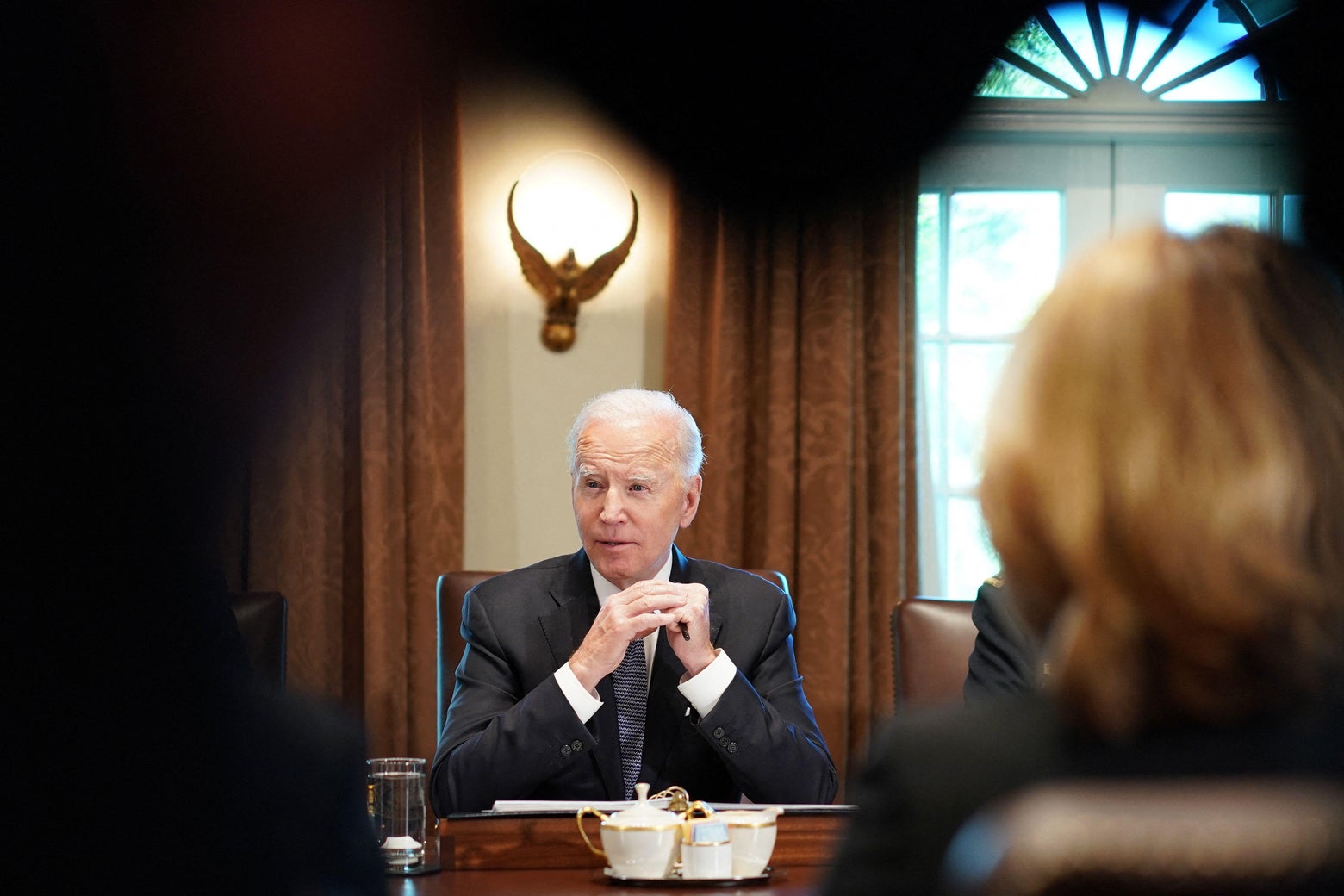
President Biden’s new cybersecurity policy allows U.S. agencies to preemptively hack into the computer networks of criminals and foreign governments.

President Biden’s new cybersecurity policy allows U.S. agencies to preemptively hack into the computer networks of criminals and foreign governments.

President Biden is about to approve a policy that goes considerably farther than any previous hard work to defend personal organizations from destructive hackers—and to retaliate against those people hackers with our very own cyberattacks.

The 35-webpage doc, titled “National Cybersecurity System,” differs from the dozen or so equivalent papers signed by presidents above the earlier quarter-century in two major strategies: Initially, it imposes required restrictions on a large swath of American industries. 2nd, it authorizes U.S. protection, intelligence, and law enforcement businesses to go on the offensive, hacking into the personal computer networks of criminals and foreign governments, in retaliation to—or preempting—their assaults on American networks.

“Our goal is to make malicious actors incapable of mounting sustained cyber-enabled strategies that would threaten the national stability or community security of the United States,” the document states in a 5-webpage area titled “Disrupt and Dismantle Risk Actions,” according to a draft completely considered by Slate. (The document has not however been publicly introduced, although it will be soon after Biden signs it, an celebration predicted sometime this month.)

Underneath the new system, the U.S. will “disrupt and dismantle” hostile networks as component of a persistent, continual campaign. This marketing campaign will be coordinated by the FBI’s Countrywide Cyber Investigative Joint Activity Power operating in tandem with all pertinent U.S. agencies—a systematic collaboration that has hardly ever been attempted and never in advance of publicized. Personal companies—both firms that are frequent targets of cyberattacks and firms that specialize in cybersecurity methods—will be whole associates in this effort and hard work, both to alert the government endeavor power of intrusions and to support repel them. (In the previous, lots of of these corporations, specifically in Silicon Valley, have been reluctant to be noticed cooperating with the government on these problems.)

The new strategy—which was in the functions for a great deal of 2022 underneath the supervision of senior White Residence officials—stems from the increasing recognition of two facts, which have lengthy been obvious to professionals.

Very first, mere guidelines on cybersecurity—which Washington has formerly allowed personal corporations to abide by voluntarily—have, for the most part, failed to block major intrusions by foreign governments or cybercriminals.

Next, purely defensive actions have also had constrained influence, as a intelligent hacker will at some point find means around them.

The United States has executed cyber-offensive operations for several a long time. Bill Clinton was the 1st president to admit this fact publicly. In 2012, Barack Obama issued Presidential Plan Directive No. 20, which set up  strict controls,  including that the president’s express permission was desired for all cyber-offensive operations. (Classified Leading Secret, it was 1 of quite a few files leaked by Edward Snowden.) In 2018, President Trump signed Nationwide Stability Presidential Memorandum No. 13, which loosened people controls, offering protection and intelligence organizations huge leeway to mount offensive campaigns on their own.

Gen. Paul Nakasone, who was and nonetheless is NSA director and Cyber Command chief (the two positions are typically held by the very same four-star officer), was the chief advocate of that strategy. In an post he afterwards wrote for Overseas Affairs, he described the mission, with its larger latitude, as “hunt forward” and “persistent engagement.”

Company lobbyists efficiently resisted necessary cybersecurity rules on private providers for several years. The new approach acknowledges that did not work.

At the time, several feared that the finish of restricted controls would unleash surplus and blowback, and eventually damage protection. But, as one particular official who utilized to be between the fearful informed me previous week, “None of individuals terrible items took place.”

As a final result, Biden and his staff made the decision to drive the Trump-Nakasone coverage even more. The technique that Biden is established to approve addresses only those people offensive functions built to disrupt hostile actors’ attempts to hack into U.S. networks. At the same time, nonetheless, the Pentagon is drafting a new cyber approach, which applies the White Home paper’s ideas to cyber procedures, both equally defensive and broadly offensive.

The other sections of the Biden paper—which involves 30 internet pages dealing with purely defensive measures—outline continue to much more drastic departures from current guidelines to protect the nation’s “critical infrastructure.” That phrase, “critical infrastructure,” was coined in the mid-1990s and refers to financial sectors—such as banking, finance, electrical power, water operates, transportation devices, telecommunications, and crisis management services—that are necessary to modern-day societies and are linked to computer networks, this means they are susceptible to cyberattacks.

Presidents Bill Clinton, George W. Bush, and Barack Obama all signed orders and created companies to bolster the resiliency of these sectors. A few aides to all 3 presidents attempted to impose necessary cybersecurity regulations on providers in these sectors, but company lobbyists efficiently resisted their endeavours, as did some financial advisers, who warned (probably accurately) that rules would curtail innovation. So enforcement of the principles has been, till now, strictly voluntary.

The new tactic stems from a recognition that voluntary actions in most of people sectors don’t function. There are exceptions—for occasion, financial institutions. Cybersecurity is central to their enterprise if they get hacked much too often, shoppers will get their deposits somewhere else banks also have the income to employ really fantastic specialists. Even so, for general public utilities, these types of as energy crops, cybersecurity is pretty costly. Mandatory regulations are needed to prod them into motion.

At the similar time, the new strategy acknowledges that  uniform expectations for all sectors—which some aides underneath earlier presidents tried using to formulate—don’t get the job done either. As an option, extra than a calendar year ago, the Biden White Property began analyzing every sector, in consultation with the federal agency that experienced authority in excess of each and every sector and with the providers that would be affected by polices.

For occasion, in accordance to a person formal, the TSA recognized 97 oil and gasoline pipelines that serviced at the very least 25,000 Us residents. The White Residence then held 3 meetings with executives of the businesses that owned the pipelines. At one assembly, just after staying vetted for protection clearances, the executives were briefed by intelligence officers on the threats their pipelines faced.

As a short while ago as a couple years in the past, lots of corporate executives perceived cyber threats as theoretical. Now they are clearly everything but.

Officials have also fulfilled with point out utility commissions on the threats to electric ability grids and on actions to increase protection. Just before Christmas, in a bill signed by Gov. Kathy Hochul, New York grew to become the initial point out to problem new necessary cybersecurity polices. It will be assisted by a number of federal specialists as perfectly as a chunk of the $1.5 billion that the White Home is allotting to states that take this leap. Similarly, this month, in accordance to 1 official, the EPA will difficulty new regulations on the cybersecurity of the nation’s waterworks.

Context is an additional massive big difference amongst Biden’s technique and earlier makes an attempt to impose rules. As just lately as a number of several years ago, quite a few company executives perceived cyber threats as theoretical. Now they are certainly something but. In 2020, Russia’s substantial hack on SolarWinds—which afflicted technique management equipment on the personal computers of more than 30,000 companies and companies included in significant infrastructure—was a big wake-up phone. In 2021, a criminal gang’s ransomware assault on Colonial Pipeline—which shut down the circulation of gasoline and jet fuel to 17 states right until Colonial paid 75 Bitcoins (at the time well worth $4.4 million) to the hacker group—was yet another.

The Colonial hack couldn’t have took place had even rudimentary stability measures been followed. It was a huge element of what led Biden to impose necessary rules on pipelines. The new system spreads such rules throughout the other vital industries.

Michael Daniel, Obama’s cyberpolicy coordinator who now heads the Cyber Threat Alliance, a nonprofit team of safety providers and IT firms, explained to me, “There’s certainly been a shift in business enterprise considering. It is one particular thing if your spreadsheets are wrecked—quite another if it’s your pacemaker. With recognition that cyberattacks can bring about physical injury, some degree of governing administration regulation is inevitable.”

Many of these companies also do small business abroad, wherever restrictions are a lot extra stringent. If they will need to follow restrictions in Europe, Australia, or Canada, they could as very well abide by them in this article, much too.

Nevertheless, the new technique won’t remedy all the troubles. There are various sectors—including foods and agriculture, unexpected emergency companies, and a number of producing industries—where Congress would require to move authorities to control. And the new Congress, at the very least on the Property aspect, doesn’t appear interested in passing significantly of anything at all, substantially fewer more rules on small business.

Even for sectors exactly where the govt department presently has authority, the strains of authority—which businesses can generate and implement which laws above whom—aren’t fully obvious. All through the drafting of the Nationwide Cybersecurity Technique, the two White Household officers in charge—Anne Neuberger, the deputy nationwide safety adviser for cyber and emerging systems (appointed by Biden), and Chris Inglis, the countrywide cyber director (a situation freshly designed by Congress just two many years back)—sometimes clashed more than these matters. Compromises ended up made, and a consensus was attained between the two of them and among the much more than 20 federal businesses. Nonetheless, there are, inevitably, some lingering ambiguities, which are to be settled in a subsequent “implementation strategy.”

It was way again in Oct 1997 when President Clinton’s Fee on Vital Infrastructure Safety warned of “cyber attacks” that could “paralyze or stress large segments of society” and “limit the flexibility of action of our nationwide leadership”—adding, “We ought to study to negotiate a new geography, the place borders are irrelevant and distances meaningless, wherever an enemy may possibly be capable to damage the important methods we depend on without the need of confronting our navy energy.”

A quarter-century later, Biden’s new strategy goes a long distance toward coming to grips with this new geography. But in a lot of techniques, we’re nevertheless negotiating.

From Log4j to zero trust, agencies have another busy year in cyber

From Log4j to zero trust, agencies have another busy year in cyber

To nobody’s surprise, 2022 was a different action-packed yr for federal chief info stability officers and cybersecurity teams across govt.

It commenced with the clear-up from the Log4j software package vulnerability, and has continued with a flurry of new advice and initiatives.

The zero-working day vulnerability in the open source Java library, known as “Log4Shell,” essentially surfaced in late November 2021 and stored stability teams hectic as a result of the holidays. The criticality of the vulnerability is owing to its prevalent…

Browse Much more

To nobody’s surprise, 2022 was yet another action-packed 12 months for federal main information safety officers and cybersecurity groups across govt.

It started off with the cleanse-up from the Log4j software package vulnerability, and has ongoing with a flurry of new advice and initiatives.

The zero-day vulnerability in the open up supply Java library, termed “Log4Shell,” actually surfaced in late November 2021 and kept protection groups chaotic by means of the holiday seasons. The criticality of the vulnerability is due to its common use in networked programs, its simplicity of exploitation, and the important accessibility it gives to productive attackers.

The Cybersecurity and Infrastructure Security Agency led attempts to remediate the vulnerability across agency networks.

“We have witnessed amazing awareness on this vulnerability across federal companies,” CISA Executive Assistant Director for Cybersecurity Eric Goldstein stated in early January. “I think, frankly, the most focused emphasis that we have ever noticed for an energy like this.”

At the identical time, CISA officials stated remediation initiatives were being far from over.

The Cyber Security Overview Board, in its to start with ever report, also warned that unpatched circumstances of Log4j will carry on to crop up for yrs to appear, perhaps up to a 10 years.

Individuals warnings came to fruition in November, when CISA unveiled an inform revealing that concerning mid-June and mid-July, it uncovered proof of Iranian-backed hackers applying Log4shell to compromise the network of an unnamed civilian company. The Washington Publish later on documented the agency in query was the Advantage Programs Defense Board.

But the Log4j incident underscored a push presently in motion to strengthen the stability of application employed across businesses. The motion was initiated by the May possibly 2021 cybersecurity executive buy, and resulted in new protected software growth tactics issued by the Nationwide Institute of Standards and Technology in the spring.

In September, the White Home Office of Administration and Finances issued very expected advice for how businesses ought to adopt the NIST tactics.

The directive, “Enhancing the Protection of the Computer software Offer Chain via Secure Software Enhancement Techniques,” applies to agencies’ use of third-party software, in turn impacting the large array of contractors and software producers in the federal procurement ecosystem.

Less than forthcoming acquisition principles, companies will require software package sellers to self-certify that they are following NIST’s protected progress techniques. The OMB advice also leaves the door open for organizations to mandate third-bash protection assessments as effectively.

It also inspired agencies to use Application Payments of Materials or SBOMs, but it did not need the use of the so-named “software components lists.” The Cyber Protection Evaluate Board in its Log4j report touted the possible use of SBOMs to maximize software transparency, whilst acknowledging more developments in SBOM tooling and adoption are continue to necessary.

The tech field, in the meantime, productively lobbied lawmakers to fall new SBOM prerequisites in the last model of the fiscal 2023 defense authorization invoice. Business associations argued SBOMs have limited utility nowadays simply because of a deficiency of standardization.

But the issue will be one particular to continue on to view in 2023. The Military is transferring forward with potential SBOM adoption across its enormous contracting apparatus. And the Nationwide Security Agency and other direct cyber businesses have endorsed their use as properly.

Zero belief procedures get off floor

The White Property also established organizations on an ambitious cybersecurity path into the long term when it launched the federal zero believe in technique in January. The system addresses a vary of pillars, but functions a “significant emphasis on more powerful organization id and access controls, which include multi-factor authentication.”

It in the end sets a objective for agencies to obtain zero rely on ideas by the stop of fiscal calendar year 2024. Each agency was needed to post an implementation strategy to the White Dwelling, as nicely.

In a new job interview, Chris DeRusha, the federal chief info stability officer, claimed the zero believe in approach has led to what he named “strategy-primarily based budgeting” in the federal cybersecurity realm.

“We were being ready to combine that into the finances procedure by having implementation strategies from each individual company, and then also managing our information calls in by means of the spending budget procedure for fiscal year 24, exactly where we did our cyber funds info phone calls aligned to the zero belief capacity space, so that we can map the tooling to the abilities to the pillars and the approach,” DeRusha reported. “And so we definitely, you can swing up and down with our info that we’ve got now, and fully grasp a real zero believe in funding selection.”

The Protection Section also launched its possess zero believe in method in late November. It lays out a roadmap for how DoD components ought to immediate their cybersecurity investments and endeavours in the coming years to arrive at a “target” stage of zero have faith in maturity more than the future five years.

DoD’s strategy contains 45 separate “capabilities” organized all over seven “pillars”: people, gadgets, networks and environments, purposes and workloads, facts, visibility and analytics, and automation and orchestration.

The Pentagon is also performing with professional cloud companies on how to integrate the zero belief standards into their choices, a notable growth as both defense and civilian agencies ever more adopt cloud providers as the basis of their IT applications.

Federal payroll website for over 170 agencies gets a cybersecurity update

Federal payroll website for over 170 agencies gets a cybersecurity update

Above 170 companies are now looking at a new login system to access federal employees’ payroll info, and other kinds of facts for human assets administration.

The Nationwide Finance Middle, an company housed underneath the Agriculture Office, has introduced a multi-variable authentication technique for its federal consumers to obtain the payroll and staff internet site.

“Our final decision to apply multi-aspect authentication is a best apply that makes it possible for NFC to safe programs by providing a multi-layered method to…

Browse Extra

Above 170 agencies are now looking at a new login procedure to entry federal employees’ payroll information, and other kinds of information for human sources administration.

The National Finance Heart, an company housed under the Agriculture Section, has released a multi-aspect authentication procedure for its federal buyers to obtain the payroll and personnel web site.

“Our conclusion to employ multi-aspect authentication is a greatest practice that allows NFC to protected techniques by providing a multi-layered method to securing user accounts, thus producing the account significantly less likely to make it possible for unauthorized obtain,” a USDA spokesperson mentioned in an electronic mail to Federal Information Network.

The NFC is 1 of the four big federal payroll companies for companies. NFC partners with additional than 170 businesses, and gives payroll products and services to much more than 600,000 federal staff — making it especially significant to protect feds’ economic information and facts with enhanced cybersecurity tactics. Multi-issue authentication demands customers to verify their identification through various techniques, intending block any users who shouldn’t have accessibility to private information.

With the web-site update, the NFC has also come to be a single of many businesses hoping to get techniques to comply with the White House’s federal cybersecurity and zero have confidence in requirements.

“USDA will go on to adhere to and carry out all federal mandates, govt orders and Nationwide Institute of Specifications and Engineering (NIST) steering to ensure the security of all worker and customers’ accounts, facts and details,” the spokesperson mentioned.

Implementing multi-element authentication is just a person part of governmentwide cybersecurity specifications for federal businesses. It’s provided, for occasion, in the Federal Details Security Modernization Act (FISMA), which demands agencies to build a possibility administration framework and be certain specified stability controls. It is also element of cybersecurity direction from NIST, as effectively as the Biden administration’s executive order on enhancing the nation’s stability. Multi-aspect authentication is furthermore a need underneath the White House’s zero have confidence in strategy, which the Biden administration introduced in January of this calendar year.

But there is even now a long way to go to attain governmentwide compliance with the White House’s security specifications. Although the White Property produced its zero trust strategy back again in January, several agencies have considering that then created only minimal development on employing multi-variable authentication. As of now, most businesses have not adopted multi-variable authentication throughout all of their units, even if they are employing it in some locations. Just 13 agencies have fully adopted the practice throughout all of their enterprises.

Some fears over cybersecurity have also arisen together with the increase of remote get the job done and telework for federal workforce, which may possibly open up the doorway to larger possible for cybersecurity hazards.

“The rising reliance on distant function has companies grappling with the challenge of unmanaged individual equipment of staff members staying utilized for function. They normally really don’t have the similar degree of defense that corporation-owned devices do, nor can these equipment be monitored for abnormal or anomalous behavior,” the spokesperson stated.

But multi-element authentication on NFC’s internet site can enable mitigate that sort of danger, according to the spokesperson. It is portion of the motive that the company carried out the adjust in Oct.

And the update to NFC’s internet site is not the only forthcoming adjust for the agency when it arrives to cybersecurity. Alongside with implementing a multi-element authentication system, the company also programs to before long increase endpoint detection and response, application source chain inventory, and asset visibility and vulnerability detection. USDA will also continue on to maintain trainings for workers on the value of guarding personalized information. All of those ideas are also necessities less than the White House’s zero have faith in guidance, as well as the cybersecurity executive get.

Some of these demands from the zero believe in guidance are beginning to get tough deadlines, far too. According to a the latest Workplace of Administration and Spending budget memo, agencies have a 90-working day deadline, setting up from Sept. 14, to inventory all of their 3rd-bash computer software.

In basic, not all kinds of multi-component authentication are similarly safe. Eric Mill, senior advisor to the federal chief information officer, has stated that SMS textual content messages and drive notifications, for occasion, are even now susceptible to phishing attacks. Mill has also said that the changes beneath the White House zero have faith in approach have a a lot more significant intention — and broader implications — than just utilizing a multi-issue authentication method for federal businesses.

“We’re looking at a key architectural change for the federal government. And we know that is a multi-year procedure,” Mill mentioned in January, when the White Home in the beginning produced the zero believe in method. “We’re making an attempt to both equally layout an oversight and timing process that reflects the urgency with which we need to move and the fact of the dimensions of the do the job that is happening.”